
An Open Letter to my University of Birmingham Colleagues
Welcome to the university of Birmingham! A new semester has begun. For newcomers, students and staff alike, this is an exciting opportunity to start a new stage of their learning or to begin a new career. The University has made great efforts to make the beginning of the academic year joyful and welcoming for all. On occasion, this joyful atmosphere was interrupted by a dozen of students whose faces were covered with keffiehs, black and white scarfs symbolising Palestine, chanting slogans asking for our institution to divest from what is now an established fact: an ongoing genocide in Gaza. They were met with a heavy-handed approach from campus security, manhandled and evicted; only to return the next day.

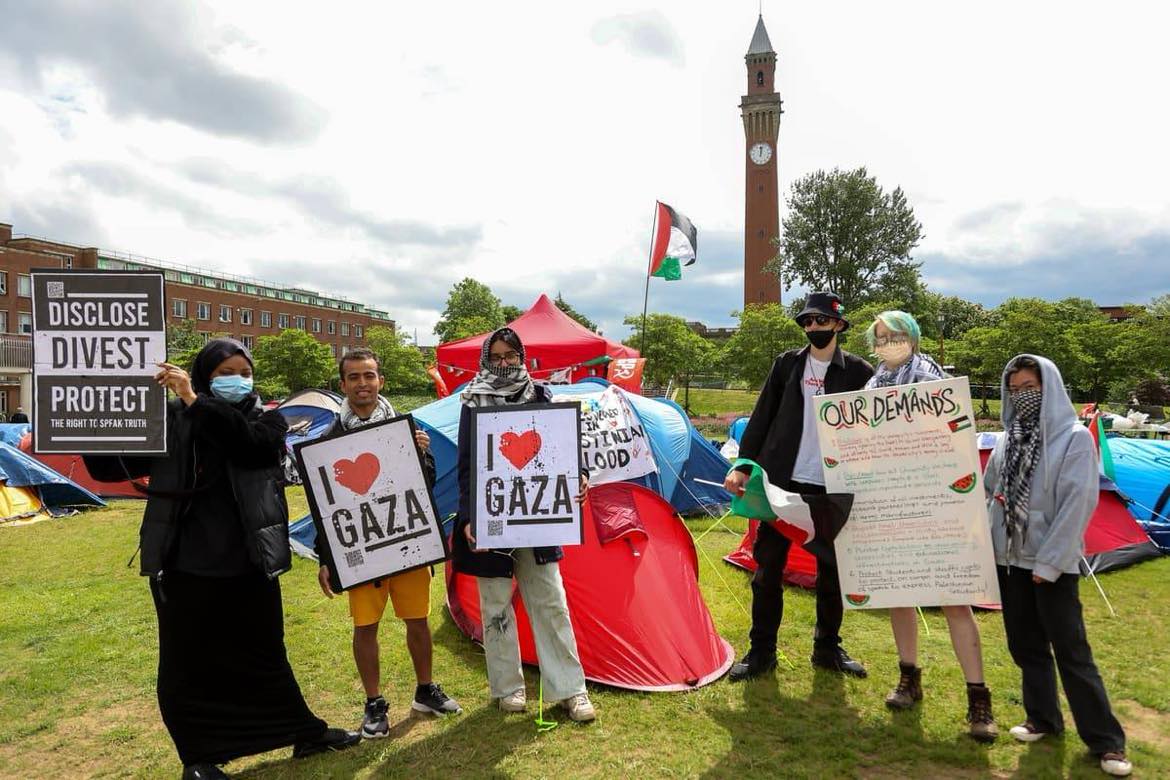
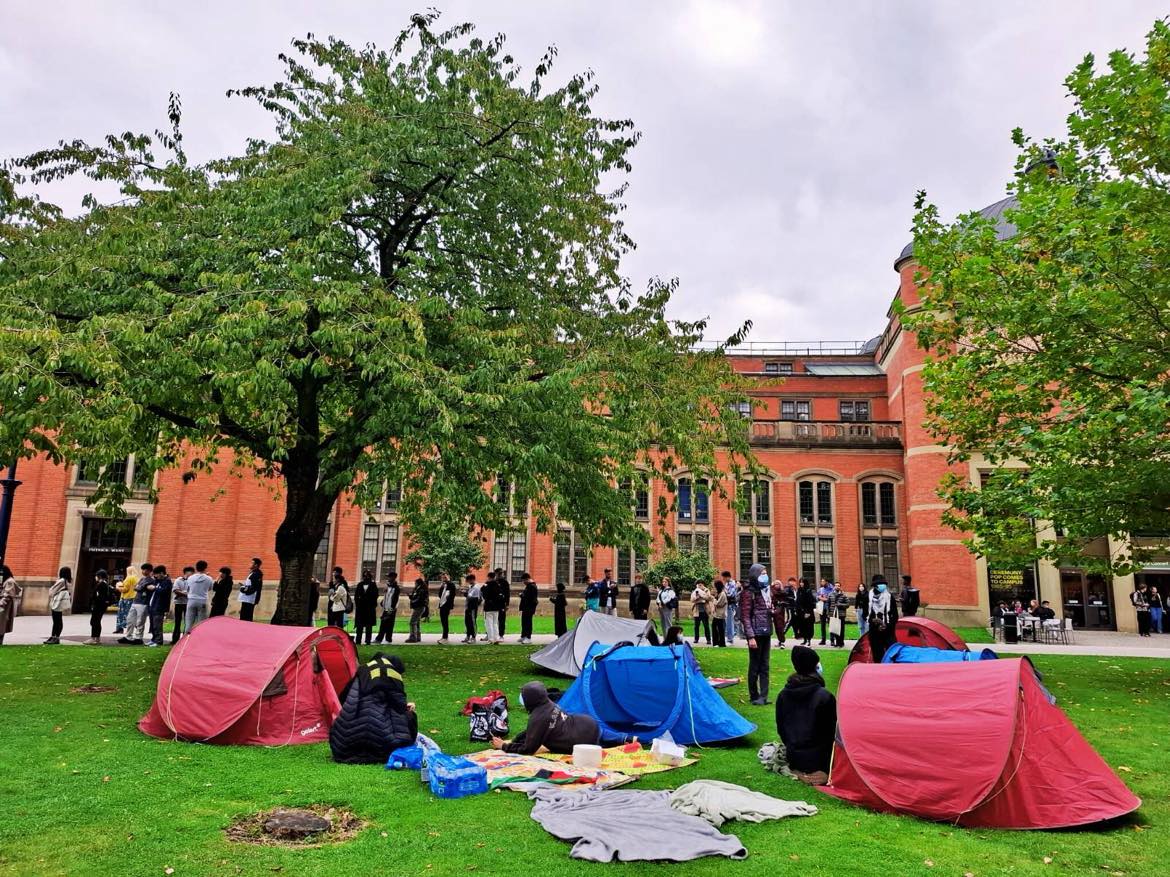
The protesting students reminded everyone that we live in two different worlds. One is the mainstream world of the media, where violence against Palestinians, in Gaza as well as in the West Bank, has become normalised. As news about the relentless bombardment and man-made famine began to disappear from our headlines, it is abundantly clear that Palestinian casualties do not matter. The wholesale dehumanisation of Palestinian life is now practically complete. This is the sanitized world to which our institution subscribes, all the while claiming a selective and duplicitous “global” status. And there is the other world, for whom the beginning of the new academic year coincides with marking one year of genocide. This other world may appear to be inhabited by a minority, largely overlapping with our BME students and staff, some of whom may be Muslims but most are probably not. For many of us, the past academic year was filled with awkward silences, some censorship, and a great amount of self-censorship. But, let us add, emphatically: while the dehumanisation of Palestinian lives can only work the way it does because of a long-standing history of devaluing Muslim lives; Palestine is emphatically not a “Muslims only” issue. It is an issue that affects us all, both on a professional and personal level.
Talking about Gaza—and about Palestine/Israel more broadly—matters more than any other atrocity or conflict that may be happening around the globe. It matters because its very status as “genocide” remains contested, despite overwhelming evidence by countless experts; and because one of the core pillars of the normalisation of anti-Palestinian violence is the very denial of history. While this may be particularly pertinent to my own department, History, it is a topic that hits at the heart of everything we do as critical scholars. Crucially, it exemplifies what “whiteness” currently means in our scholarly institutional landscape.
As scholars, we have been trained—and are literally paid—to historicize, to contextualise, to compare, and to critically evaluate evidence. Yet, “historicising” and “contextualising” when it comes to Gaza (and more broadly, to Israel/Palestine) have become dirty words. At stake is our professional dignity. The failure to think critically—and to push back against censorship and self-censorship alike—is what enables the banality of evil.
It is our professional duty to not remain silent. The first thing is to insist that criticism of Israel is not anti-Semitic. For many of us, criticizing states is conventional; indeed, at the History department we teach the modern history of the US, Germany, Russia, or China—or indeed of the UK—as a long litany of critiques. Yet, there is a red line when it comes to Israel. The reason, for many within the academic community, is the fear of being accused of antisemitism. Hence otherwise confident and outspoken intellectuals worry that they could trespass on dangerous territory replete with historical baggage that they understand poorly. Given the potential reputational cost of being seen as critical of the establishment of Israel as reparation for an unspeakable crime, protecting Jewish friends and defending their right to statehood remains paramount. This is particularly true for older generations raised on mythologies of progressive Zionist pioneers—an image they would never accept if it were framed as mythologies of European settlers in North America. But if we refuse to engage with history, we risk colluding in another historical injustice of mammoth proportions. Refusing to criticise Israel—maintaining Israeli exceptionalism—has everything to do with race, and with perspective.
Many of us devote a large part of our teaching or research to understanding race historically, and on making visible the racial dynamics behind historical events; many others work on colonial and settler colonial societies, and have developed a nuanced understanding of the role of violence in anti-colonial struggles around the globe. So let us use some of our professional toolkit and try to do better. Many of us who teach history spend some time in introductory seminars explaining that race is not a “real” biological fact, but a social construct which morphs over time and place. The most common example we give is that of the Irish, the Italians, or the Greeks who were only included into the category of “whiteness” through the early decades of the 20th century. Those of us of East European origin have lived through a similar process of “whitening” in the post-Cold War era, as the result of our countries’ inclusion into the EU and NATO; the Ukrainians are going through this process now. But race also morphs synchronously, if observed from a different geographical vantage points. The same Irish, or indeed Jews, not accepted as “white” a century ago in the UK or USA, only needed to go to the Caribbean, South Africa or indeed to the Middle East, to immediately own this label. And here is my point: while Jews had to fight for their inclusion into whiteness in the Global North—a status they constantly have to defend, as antisemitism here is indeed alive and kicking—there has rarely been any doubt that from the perspective of the Global South they are unquestionably “white.” (There are, of course, “black Jews”: those who came to Israel from Iraq, Yemen or other parts of the Middle East and Africa, and who have been coopted into the settler-colonial project; they prove, yet again, that “blackness” or “whiteness” are not skin colours but political positions with a history). Seen from that perspective, Israel has always been a white settler-colonial project. It was born as such, and has behaved as such throughout its history, with considerable material support from the US and Europe. Likewise, it would seem, for significant (though by no means all) portions of the Israeli establishment and publics, the current war on Gaza represents an opportunity to complete this settler-colonial project.
The elephant in the room is Zionism, and the persistent, erroneous conflation of Zionism with Jewishness. A late 19th century political ideology, Zionism was a reaction to failed assimilation in Europe and the persistence of anti-Semitism within rapidly modernising, secular societies, of which the Dreyfuss affair is just one famous example. Hence Zionism sought to establish a Jewish national home elsewhere. While most critical scholars understand Zionism as a form of racism given its rootedness in racial exclusivity, others see it as a legitimate expression of Jewish national aspirations. In either case, this ideology found its expression in a colonial-settler movement, and later Israeli ethno-nationalism based on the capture of land; first in Ottoman Palestine, and later continued through the militarisation of Israeli society and its wars of expansion.
The settler-colonial dimension of Israeli history is absolutely crucial; and indeed has become the increasingly dominant analytical lens among scholars over the past decade seeking to understand the history of the region. Distinct from “classic” colonialism predicated on the extraction of resources to benefit the metropole, settler-colonialism stands out by a unique set of relationships to both “here” and “there:” firstly, a severed link to a “mother country” (in the Israeli case, numerous “home countries”), as settlers seek to establish a New Homeland; and secondly, the erasure of the native population by various means.1 Theosophical militarism, the capture of land, population transfers, mass killing, dispossession, dehumanisation, assimilation, and bantustanization are all long-standing features of this process. Crucially for my argument, Israel’s settler-colonial character has been evident to publics across the Global South for decades. Since at least the 1960s, the Liberation of Palestine has become an iconic cause for liberation movements around the world, from the Civil Rights movement to the struggle against South African apartheid.
This colonial dimension is plainly evident in the position taken by international actors whereby being “with,” or “against” the ICJ case maps fairly neatly onto former colonial boundaries. As several observers have noted, the ICJ case amounted to an indictment of the Global North by countries of the Global South. Antisemitism is not their problem; antisemitism is a form of racism that is native to the Global North, its later adoption by actors in the region notwithstanding.2 The continued unconditional support of Israel—by regimes and publics of the Global North alike—is reminiscent of a long history of gaslighting of non-white voices, whether by colonial overlords or by well-meaning but patronising allies.
And this is where we, citizens of the Global North and especially those of us racialised as white, need to cease being silent. Our first duty is to categorically refuse the proposition—forced upon us by our institutions’ adoption of the IHRA definition of antisemitism which remains deeply controversial—that any kind of criticism of Israel is antisemitic. If we continue colluding in Israeli exceptionalism—the perception that Israel is above international law—our silence has deadly effects. On the immediate level, it enables the genocide of Palestinians to proceed. On the broader level, it gaslights the Global South, and perpetuates colonialism not just as a tangible geopolitical relationship but as a persistent structure of thought. The onus of explaining itself is, again, on the Global South, who is here also infantilised as the one who simply does not understand the higher goal of defending “our Jewish friends,” which really means defending Zionism. Our tone-deafness sends the message that voices from the Global South—or, indeed and more to the point, our students, colleagues or neighbours who are racialised as “non-white” —are deluded; that they are not quite mature enough to understand our higher purpose of defending the Jews from antisemitism.
But in fact, what the voices of those racialised as minorities understand rather brilliantly is the chameleonic, or performative, nature of race. They can see clearly how Israel plays the victimised minority “here,” weaponising antisemitism and a long history of persecution in Europe, while “out there,” this same Israel stands for the very embodiment of white settler racism posing as the defender of civilisation against the barbarians.
This censure also sends the message that not all genocides are alike. The genocide of the Jews (seen as unquestionably “white” from the Global South perspective) is placed above all other genocides committed on “non-white” people. From the perspective of our BME students, many of whom are under intense scrutiny for their pro-Palestinian advocacy, this gaslighting amounts to defending white privilege. Privileging Jewish feelings over the anger expressed by pro-Palestinian demonstrators across our universities’ campuses amounts to privileging white feelings, yet again. At the same time, it yet again conflates Jewishness with Zionism. Those unable to see the difference between Jewishness and Zionism (whether by design, fear, or by sheer ignorance), are prioritising a deeply contentious political ideology. An ideology which is currently underpinning the ethnic cleansing of Palestinians, as it has done for 8 decades now. As many non-Zionist Jewish voices continue pointing out, by censoring the criticism of Israel, we are doing Jews a great disservice. We are also placing ourselves in some very bad company. This support for what, from the perspective of those racialised as non-white, is unquestionably the defence of white privilege, is bound to enrage, and possibly to radicalise. Racialised minorities are literally tired of having to explain themselves again and again, and being ridiculed, gaslit, dehumanised, and cancelled.
The settler-colonial paradigm helps us, as scholars, to understand the “why” and the “how.” It exposes the long-standing fallacy of conceptualising the events in Israel-Palestine as a “conflict” (invariably dismissed or eschewed as “too complicated to understand”), and the all too apparent failure of the “peace process” (imposed by a colonising power, pointedly refusing to articulate Palestinian rights, yet always blamed on the Palestinians when it so predictably fails); as it also explains why the options on the ground are unworkable in their current form, both the “two-state” and “one-state” solutions. The settler-colonial lens helps us to explain the systematic violence on the ground without any end in sight. It explains why the Netanyahu government’s actions make no sense from a pragmatic perspective, be it military or political. The problem is not Netanyahu. The goal of the Zionist movement’s leadership has always been to establish an exclusively Jewish state in Palestine; whether they said it openly or not, eliminating the (rival) native was a strategic necessity. This sometimes took the form of “transfer” of the local Palestinian population; and when transfer was impossible, colonial exploitation replaced settler-colonial expulsion.3 The scale of violence committed by Hamas on the 7th October has provided the perfect opportunity to carry this out. For large portions of Israeli society and for its establishment, the current war on Gaza—and increasingly, beyond—is the completion of this project of ethnic cleansing and dispossession, as many Israeli public figures make abundantly clear, without shame and without fear.
Understanding the settler-colonial paradigm also takes us a step closer towards intellectual honesty, on two levels. Firstly, historicising, contextualising, and critically questioning evidence is what we as academics do, and insisting on doing just that is the only way to maintain our professional and personal integrity. The protesting students on our campus remind us of this integrity.
Secondly, it allows an ethical way forward, encouraging us to draw inspiration from the ways that other settler-colonial societies have attempted to deal with their violent pasts, albeit to varying degrees of success. There is of course a question of whether it is already too late to imagine an end to this violence. Nevertheless, given the current state of affairs on the ground in Israel/Palestine, the only thing we can do, and absolutely must do, is both selfish and liberatory: to decolonise our minds, by recognising how our silences work to reproduce whiteness as a structure of thought. The wholesale dehumanisation of Palestinians, and the gaslighting and intimidation of those who dare to defend them, is alarmingly reminiscent of the status of Jews in late 19th century Europe—and indeed through much of European history. We must not allow anti-Palestinianism to become the new antisemitism of our time. Now, like then, being silent implies taking a position. We all must refuse to be complicit.
By Lucie Ryzova, on behalf of the BUCU committee
- Of course, every paradigm always needs refining for each specific context. In the Israeli case, there are specificities: firstly, the link to a “mother country” never existed in the same form as it did for other “classic” settler-colonial societies, such as the USA, Canada, or Australia. Rather, there was, and remains, an active and crucial link to the diaspora. Secondly, Zionist settlers could claim a link to the land, as Ottoman Palestine indeed had its own local Jewish community, amounting to about a tenth of the total population at the onset of the British mandate. ↩︎
- The term “native” here is important. Today, both state and non-state actors across the Middle East routinely deploy antisemitic tropes against Israel; this is, however, a recent phenomenon that emerged through the later 20th century. See, for instance, Bernard Lewis, The Jews of Islam (1984); Israel Gershoni and James Jankowski, Confronting Fascism in Egypt: Dictatorship versus Democracy in the 1930s (2009); Avi Shlaim, Three Worlds: A Memoir of an Arab Jew (2023). ↩︎
- For transfer, see, for instance: Ilan Pappe, The Ethnic Cleansing of Palestine (2006); Nur Masalha, The Expulsion of the Palestinians: The concept of “Transfer” in Zionist Political Thought, 1882-1984 (1992). For colonial exploitation, see Adam Hanieh, Lineages of Revolt: Issues of Contemporary Capitalism in the Middle East (2013), especially Chapter 5; Andy Clarno, “Neoliberal Colonization in the West Bank,” Social Problems (2018); Oren Yiftachel, “Deepening Apartheid: The Political Geography of Colonizing Israel/Palestine” Frontiers in Political Science (2023). ↩︎

 Birmingham UCU
Leave a comment